
AMS Nuclear Logo icon

Project Overview

Type: C&I Systems Engineering

Scope Of Supply: Site Survey, Optioneering, Design, Installation, Commissioning

Market Sector: Decommissioning

As part of ongoing decommissioning works at Hinkley Point A, Magnox required a future-proof replacement for a critical site-wide Public Address (PA) system located within areas scheduled for demolition. AMS Nuclear delivered a fully integrated, radio-based communications system that maintained uninterrupted operational coverage throughout installation, enhanced system reliability, and supported long-term maintainability.

Drawing on extensive experience in safety-critical EC&I systems, AMS Nuclear combined detailed site understanding, intelligent reuse of existing assets, and robust quality-led engineering to deliver a compliant and adaptable solution. Delivered over a 17-week programme, the system improved fault detection capability, optimised lifecycle costs and ensured continuous communication coverage without disruption to ongoing operations.


Maintaining Critical Communications in a Changing Site Environment

As part of Hinkley Point A’s progressive decommissioning programme, key infrastructure within the Turbine Hall area, including elements of the existing PA system, was due to be removed.

The PA system is essential for broadcasting operational messages, fire alarms and incident alerts across the site. Maintaining this capability during structural changes was critical to ensuring continued safe operations.

However, the fixed and distributed nature of the legacy system meant relocation was not viable. A replacement solution was required that could:

  • Operate independently of demolition zones
  • Integrate with existing site infrastructure
  • Provide reliable, site-wide coverage
  • Support future changes in site layout

At the same time, partially installed legacy wireless PA equipment presented an opportunity, if validated, for reuse within a modern system. This required a partner capable of assessing legacy assets, working within nuclear site constraints and delivering a solution that balanced innovation with practical site realities.

Overcoming Infrastructure Constraints Without Disrupting Operations

The challenge was not simply to replace a PA system, but to do so in a live nuclear environment undergoing physical transformation.

Key constraints included:

  • Maintaining continuous communication and alarm functionality during transition
  • Working within radiologically controlled areas (RCA) and existing site constraints
  • Limited availability of legacy system documentation
  • The need to assess and potentially reuse decommissioned equipment
  • Coordinating with multiple stakeholders, including equipment suppliers and site teams

AMS Nuclear approached this as an engineering problem to be solved collaboratively, combining site experience with structured engineering processes to ensure the solution was both technically robust and operationally practical.

Public Address Receiver Fixed Unit

“We needed a solution that would adapt to the site, not the other way around. That meant understanding what we could reuse, what we had to redesign and how to keep the system live throughout.”

Project Lead, AMS Nuclear

Engineering a Flexible, Radio-Based Communication Solution

AMS Nuclear designed a distributed, digital radio-based PA system tailored to the operational realities of the site.

The system architecture included:

  • Two operator consoles located in the Security Lodge and Shift Leader’s Office
  • A central radio repeater base station installed within the PABX room
  • Fixed outstations connected to existing speaker zones
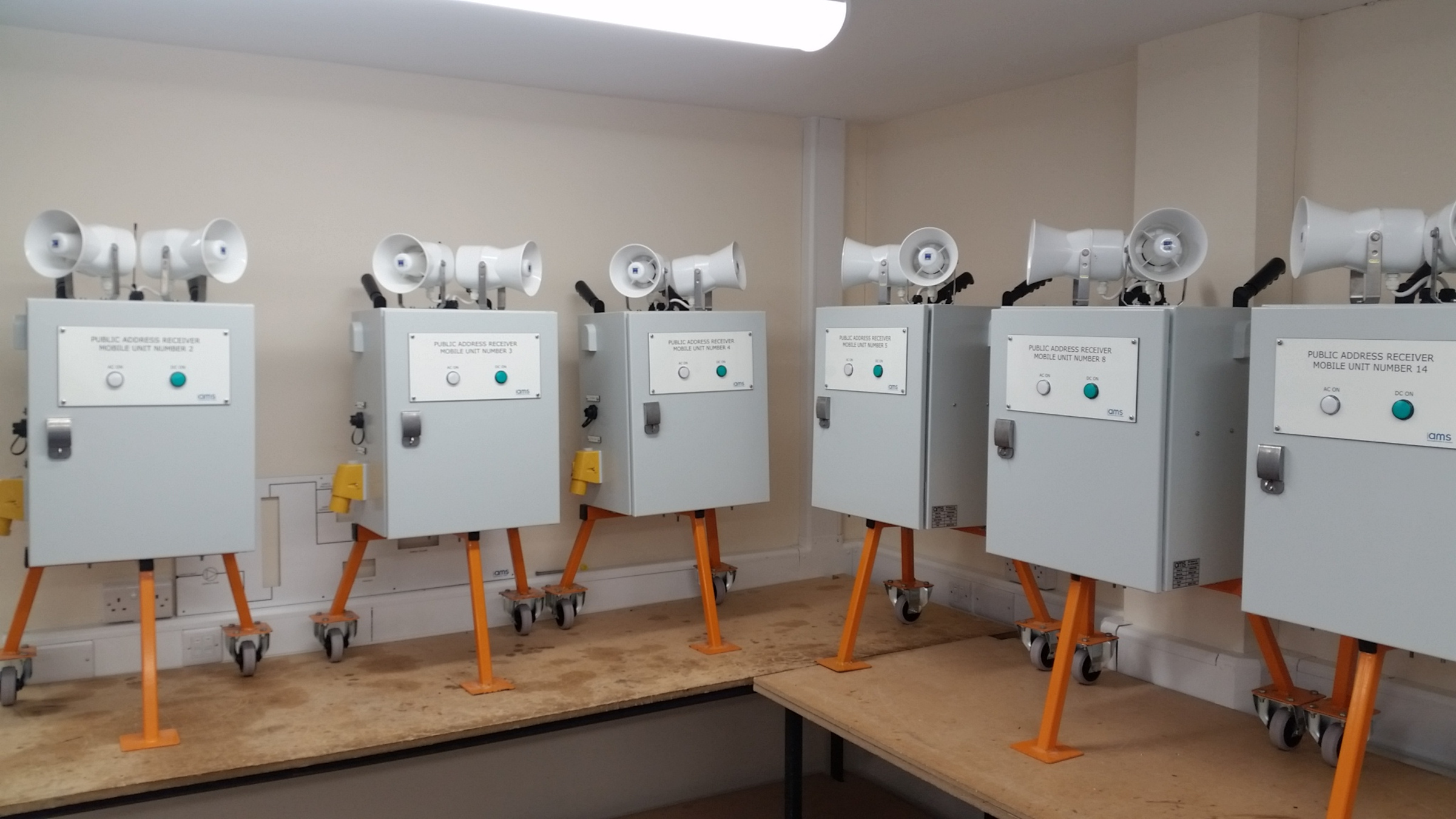
  • Mobile outstations and handheld receivers for flexible coverage
  • Integrated system health monitoring to support maintenance and fault finding

A defining feature of the solution was the intelligent reuse of legacy assets. During the site survey, AMS Nuclear identified components from a decommissioned analogue wireless system that could be refurbished and integrated into the new design.

Where documentation was unavailable, AMS Nuclear reverse engineered equipment to produce new design data, ensuring full traceability and compliance with nuclear quality standards.

All designs were developed under formal quality plans and verified through Factory Acceptance Testing (FAT) prior to deployment.

Delivering a Controlled Transition with Zero Loss of Coverage

The project was delivered in four structured phases, ensuring control, transparency and continuity throughout.

Understanding the Site Through Detailed Survey

AMS Nuclear conducted a comprehensive site survey, assessing:

  • Equipment condition and suitability for reuse
  • Power supplies, cabling, and installation constraints
  • Acoustic performance across speaker zones

This informed both the design and the delivery strategy.

Designing and Building with Quality at the Core

A full design package was developed, including:

  • System schematics and layout drawings
  • Manufacturing and design quality plans
  • Test documentation and data dossiers

System components were manufactured, refurbished, and assembled off-site before undergoing full system testing.

Installing Without Interrupting Operations

Installation was carefully phased to maintain full system availability:

  • New and legacy systems operated in parallel during changeover
  • Speaker zones were migrated individually and tested before progressing
  • Operator consoles were temporarily installed to enable seamless transition

This approach ensured that communication capability was never compromised.

Completing and Supporting the Transition

Final works included:

  • Removal and preservation of legacy equipment
  • Delivery of full documentation and spares information
  • System handover aligned with site operational requirements

The entire programme was completed within a 17-week timeframe from order placement.

Innovation Through Adaptation and Reuse

This project highlights a pragmatic and forward-thinking approach to engineering in the nuclear sector.

Key lessons and innovations include:

  • Designing for Change: Distributed radio systems provide flexibility for sites undergoing phased decommissioning
  • Maximising Asset Value: Refurbishment and reuse can deliver significant benefits when managed under robust QA processes
  • Maintaining Operational Continuity: Parallel system operation is essential for safety-critical upgrades
  • Engineering Without Complete Data: Reverse engineering enables progress where legacy documentation is incomplete

These practices are directly applicable across the UK nuclear fleet, particularly in environments where ageing infrastructure and evolving site conditions must be managed together.

This project demonstrates AMS Nuclear’s ability to solve complex EC&I challenges with clarity, accountability and technical rigour – delivering solutions that support safe, reliable nuclear operations both now and in the future.

AMS Nuclear Certifications

ISO 9001:2015
ISO 14001:2015
ISO 45001:2018
Cyber Essentials