

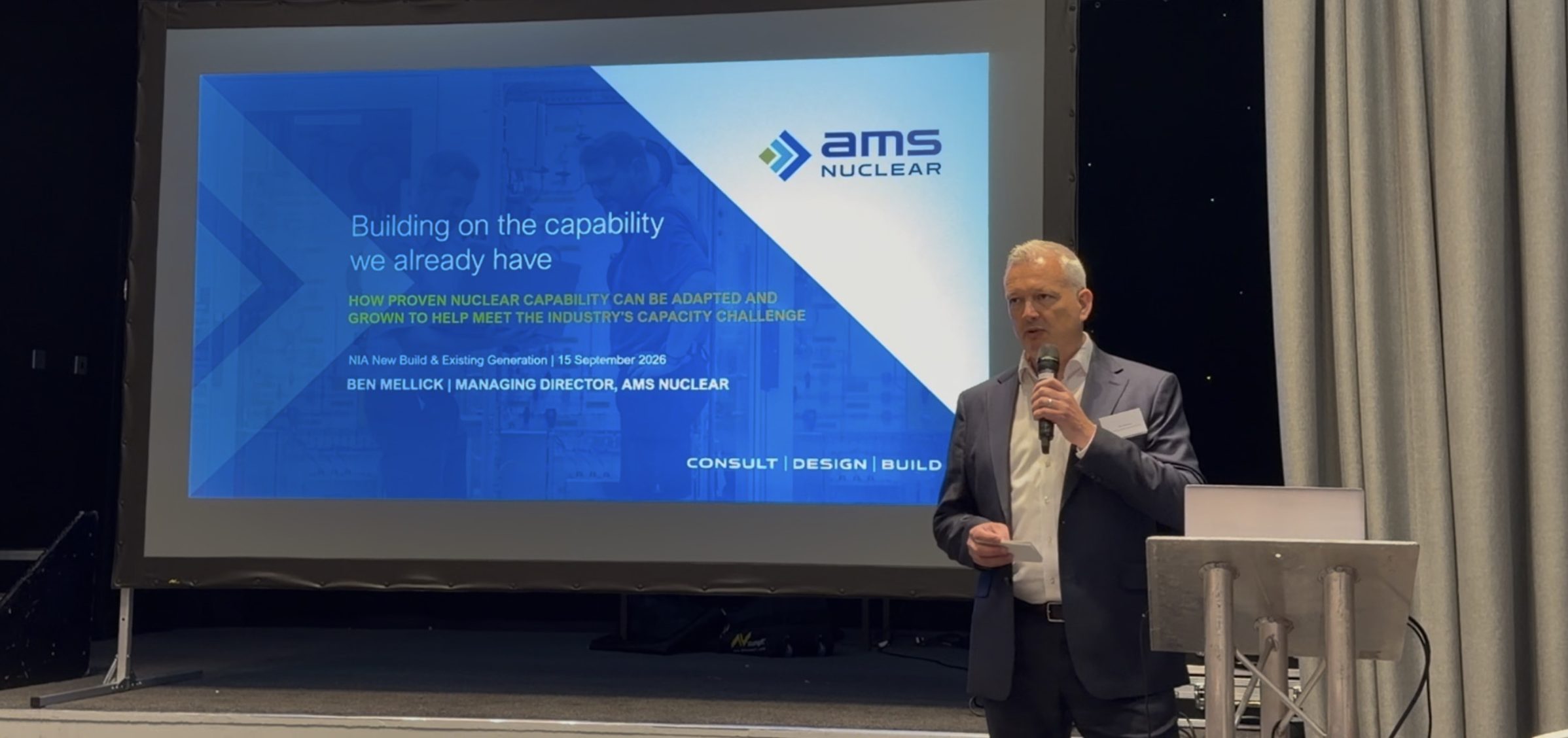


Executive Summary
The UK nuclear industry needs more delivery capacity across Existing Generation, New Build and other major programmes. Some of that capacity must be created from the ground up through recruitment, training, new entrants and investment. But there is also proven capability already present within the supply chain, including within specialist small and medium-sized enterprises. The practical question is how more of that capability can be deployed at the scale, pace and level of assurance that future programmes require.
AMS Nuclear Engineering’s experience suggests that established capability can provide a strong platform for growth, but transfer between programmes is not automatic. The technical competence, judgement, ownership, agility and nuclear discipline developed through years of supporting operating stations proved valuable when AMS Nuclear moved into Hinkley Point C. The delivery environment was nevertheless different. Larger and longer projects, more interfaces, more onerous contractual arrangements, different approval routes and a much greater volume of project and quality records required the company to adapt.
That adaptation was not a one-way cost. New Build strengthened AMS Nuclear’s project controls, commercial understanding, document management, quality-record strategy and ability to manage complex interfaces. Those capabilities now support work across a wider range of nuclear programmes. The experience therefore points to a cumulative model: one programme develops a foundation; another tests and extends it; the resulting capability becomes useful elsewhere.
This paper proposes a simple way to approach that opportunity. Programme owners, Tier 1 organisations and suppliers should identify what proven capability already exists, establish what must change for a different delivery environment and invest deliberately in what is genuinely missing. In shorthand, the task is to recognise, adapt and build.
Proven capability is not the same as spare capacity, but it can provide a platform on which additional capacity is built.
 Proven capability is not the same as spare capacity, but it can provide a platform on which additional capacity is built.
Ben Mellick, Managing Director
The Capacity Challenge
The nuclear sector is asking more of its supply chain. Existing Generation still requires dependable support, while large New Build programmes, defence, decommissioning and emerging technologies create further demand for people, specialist skills and organisations able to deliver in a regulated environment. The familiar response is to recruit and train more people, attract new companies and expand existing facilities. All of those measures matter.
They do not, however, exhaust the options. The UK already has organisations that understand nuclear safety culture, technical assurance, controlled documentation, configuration management and the consequences of poor delivery. Some are large businesses with extensive resources. Others are specialist SMEs whose capability has been built through years of solving difficult problems on operating plants.
The presence of that capability does not mean those businesses are waiting with unused teams. In most cases, capable people are already busy. The opportunity lies elsewhere: an established nuclear organisation can be a nucleus around which additional people, systems, facilities and delivery bandwidth are developed. Growing from a proven foundation is different from trying to create the full organisational capability from scratch.
AMS Nuclear offers one example rather than a complete model for the industry. The company spent many years supporting operating nuclear stations before starting work at Hinkley Point C in 2020, initially as a Tier 2 supplier and later as a direct Tier 1 supplier. Its experience shows both the value of capability developed in Existing Generation and the work required to make that capability effective in New Build.
What Proven Capability Looks Like
Capability is easy to claim and difficult to prove. In nuclear, the most valuable part of it is often built long before a sales conversation begins. Repeated delivery develops technical competence, but it also develops the judgement and behaviours that determine whether an organisation can be trusted with safety-significant work.
For AMS Nuclear, Existing Generation developed several closely connected strengths. Engineers learned to interpret requirements in the context of real plant and to understand what mattered to the safety function. Teams took ownership of customer problems rather than treating the scope as a boundary beyond which they had no interest. A relatively flat SME structure supported quick decisions and mobilisation when outages, emerging work or event-recovery situations created genuine urgency. Controlled documents, configuration management, quality records and formal review were understood as part of the engineering rather than administration surrounding it.
Trust emerged from those behaviours being demonstrated consistently. One formative example came when an EDF Event Recovery Manager visited AMS Nuclear to assess whether a relatively small company could take over an important package after a much larger supplier had struggled. The discussion was direct: could AMS Nuclear do the work, did it understand the responsibility and could it be trusted? AMS Nuclear secured the initial package, valued at about £1 million, delivered it successfully and saw the work develop to around £3.5 million over subsequent years.
The point is not the contract value. It is that the decisive evidence had been accumulated over years. Technical competence mattered, but so did the organisation’s judgement, responsiveness, discipline and record of delivery. These are assets that may not be obvious in a conventional supplier assessment, particularly when company size is used as a proxy for capability.
Capability and Capacity are Different
A clear distinction is needed between capability and capacity. Capability answers whether an organisation can perform the work to the required standard. Capacity describes how much work it can take on, when it can mobilise and whether it can sustain delivery. A company may be demonstrably capable while having little spare capacity at a particular point in time.
This distinction matters because the argument for better use of existing suppliers can otherwise sound like a claim that the industry has a hidden reserve of idle engineers. It does not. The stronger claim is that proven organisations reduce part of the risk involved in growth. They already have a nuclear culture, a working quality system, experienced leadership, delivery processes and people who understand the standards expected. New recruits and additional systems can be developed around that base.
AMS Nuclear’s own growth followed this pattern. Hinkley Point C created the confidence to invest in larger premises and additional engineering, production, project-management and document-control capability. The company still had to recruit, train and change its systems; existing capability did not remove that work. It made the investment more coherent because the additional capacity was being built around an organisation that already knew what good nuclear delivery looked like.
AMS Nuclear's Offer
The move from Existing Generation to New Build exposed a second distinction. Proven nuclear capability travels, but it does not arrive ready-made for every environment. AMS Nuclear entered Hinkley Point C with a strong safety culture, disciplined quality processes, technical judgement and experience of challenge and assurance. Those foundations transferred well.
The surrounding delivery system did not. Projects were larger, longer and involved more organisational interfaces. Contract mechanisms carried greater commercial exposure. Document structures, review cycles and approval routes differed from those used in Generation. Project management, commercial management and document control became much larger parts of the work. A reputation established with EDF’s operating fleet did not automatically create the same trust with NNB or with the Tier organisations delivering Hinkley Point C. That trust had to be earned again through delivery.
Some of AMS Nuclear’s earliest New Build learning occurred while the work was already under way. A senior project manager with experience of very large contracts helped the company understand how engineering, manufacturing, project-control and quality information would need to be structured and presented. Later projects introduced different customer interfaces again. Over time, AMS Nuclear learned to distinguish the enduring nuclear principles from the programme-specific methods used to demonstrate them.
This is an important qualification to any call for greater SME participation. Previous nuclear experience is not a waiver from the requirements of a new programme. Suppliers have to understand the new environment and be candid about where they need to improve. Equally, customers and Tier 1s can make the transition more efficient by explaining early which requirements are genuinely different, why they matter and what acceptable evidence will look like.
Equipment Qualification as an Example
Equipment Qualification provides a useful technical example. AMS Nuclear came to Hinkley Point C with significant qualification experience from Existing Generation. The underlying discipline was familiar, but the framework was different. The work had to respond to the RCC-E approach used for the EPR, UK regulatory and safety-case expectations and project-specific requirements. These did not always align neatly.
The route through that complexity was not to assume that one familiar code should dominate. It was to return to the engineering purpose. What safety function must the equipment perform? What service and accident conditions will it experience? For how long must it operate? What evidence demonstrates, with sufficient confidence, that the function will be maintained?
Those questions allowed the parties to work through differences and agree an appropriate qualification route. The transferable asset was therefore not simply familiarity with one code or process. It was the first-principles understanding needed to interpret a new framework without losing sight of the safety objective.
The same principle applies outside Equipment Qualification. A supplier may bring deep technical knowledge, strong nuclear behaviours and sound engineering judgement while still needing to learn a programme’s controls, interfaces and evidence requirements. Effective capability transfer depends on separating the underlying competence from the particular system through which it must be demonstrated.
New Programmes should Strengthen Capability
The transfer between programmes should not be viewed only as a process of preserving an existing supplier. New work can leave the supplier more capable than it was before. That has been a significant part of AMS Nuclear’s experience.
Hinkley Point C pushed the company to strengthen project controls, contractual and commercial understanding, document management and interface management. AMS Nuclear developed its Lifetime Quality Records partitioning strategy, a more structured Learning from Experience process and a stronger approach to Counterfeit, Fraudulent and Suspect Items. The quality system continued to mature, including the adoption of relevant ISO 19443 requirements. Client feedback has identified elements of this work, including the LTQR strategy, as good practice.
These improvements now apply beyond the programme that prompted them. Existing Generation built one layer of capability. New Build required that layer to be adapted and added another. The combined capability now supports larger and more complex work in other parts of the nuclear industry, including Defence work at Devonport.
This cumulative effect is strategically important. When every programme treats supplier development as a temporary cost attached to one contract, the wider industry gains less from the investment. When learning, systems and people remain within capable organisations and are carried into later work, one programme helps create capacity for the next.
Reducing the Friction of Transfer
AMS Nuclear made the transition successfully, but much of the adaptation happened while delivering live work. With hindsight, some differences could have been identified earlier. The difficulty is that a supplier cannot always know what it does not know until it is close enough to a programme to see the interfaces, contractual mechanisms, document structures and assurance expectations in detail.
This creates a practical problem. Early engagement and preparation require time and investment, yet neither the supplier nor the customer can assume a contract will follow. Some information may be commercially sensitive. Programme teams are also under pressure and may reasonably expect approved suppliers to arrive ready to deliver. These constraints are real, but they do not remove the value of a more structured transition.
Programme owners and Tier 1 organisations can help by distinguishing between the standards that protect safety and quality and the programme-specific methods used to evidence compliance. They can provide clearer routes into technical and delivery interfaces, share representative document expectations early, identify where existing evidence can be reused and explain where a different approach is essential. This is not about lowering standards. It is about allowing suppliers to prepare for them deliberately.
Commercial arrangements also matter. A specialist SME may be technically well suited to a package but unable to accept liabilities designed for a much larger Tier 1 organisation. Flowing obligations down the supply chain without considering proportionality can leave useful capability outside the delivery model. The answer is not to move risk indiscriminately back to the client, but to allocate and mitigate it in a way that reflects the party best able to control it.
Suppliers have responsibilities of their own. They should not treat a long nuclear pedigree as proof that no adaptation is required. They need adequate project management, document control, commercial competence and organisational resilience. They must be open about gaps and willing to invest where the opportunity and programme pipeline justify it. Growth has to preserve the culture and judgement that made the organisation capable in the first place.
A useful starting point is to separate the task into three decisions. The sequence is simple enough to use when shaping a work package, assessing a supplier or planning organisational growth, but each decision requires evidence rather than assumption.
| Recognise | Adapt | Build |
|
What proven capability already exists and could contribute? |
What must change for that capability to work effectively in this environment? | What additional capability or capacity is genuinely missing? |
|
Look beyond company size and familiar supplier lists. Examine technical competence, judgement, behaviours, systems and evidence from repeated delivery. |
Define the new interfaces, controls, contractual requirements, records, approvals and programme-specific expectations. Agree how gaps will be closed. | Invest in people, leadership, systems, facilities, approvals and supply-chain depth where the required capacity cannot be created by transfer alone. |
The three decisions are interdependent. Recognition without adaptation risks placing a capable supplier into a delivery system for which it is not ready. Adaptation without recognition can lead to proven knowledge being discarded and unnecessary work being repeated. Building without either can create activity without addressing the true gap.
The strongest application is collaborative. The supplier understands its own capability and limitations. The Tier 1 understands the package, interfaces and contract. The programme owner understands the safety case, assurance model and long-term demand. Bringing those perspectives together early makes it more likely that the industry will invest in the right things.
Implications for the Nuclear Supply Chain
This perspective leads to several practical implications.
- Supplier assessments should examine the foundations from which capacity can be grown, not only the resource that is immediately available on a particular date.
- Work packages should expose the real technical and delivery interfaces early enough for specialist suppliers to understand how their capability will need to change.
- Programme-specific assurance and documentation should be explained clearly, with existing evidence reused where it remains valid and duplication avoided where it adds no safety or delivery value.
- Commercial structures and liabilities should remain demanding but proportionate to the scope, influence and resources of the organisation accepting them.
- Suppliers should treat project controls, commercial competence, document management and organisational resilience as part of delivery capability rather than support functions that can be added later.
- A credible long-term pipeline matters because businesses invest in people and systems when they have sufficient confidence that the capability will be used beyond one isolated package.
None of these implications removes the need for competition, independent assurance or exacting standards. They are intended to help the industry direct effort towards the parts of supplier development that genuinely increase delivery confidence.
Conclusion
The nuclear industry’s capacity challenge cannot be solved by one route. More people must be trained, existing businesses must grow, new organisations must enter the sector and facilities and systems must be expanded. Alongside that work, the industry can make better use of capability that has already been built through years of real nuclear delivery.
AMS Nuclear’s journey from Existing Generation into Hinkley Point C shows both the potential and the limits of transfer. Technical competence, judgement, ownership, agility and nuclear discipline provided a strong foundation. They did not remove the need to adapt project controls, contracts, document management, interfaces and assurance evidence. The transition succeeded because the underlying capability was real and the organisation was willing to change.
The process also made AMS Nuclear more capable. That is the outcome the wider industry should seek: not merely moving a supplier from one programme to another, but using each programme to strengthen the organisations that will be needed for the work that follows.
If we recognise what already exists, adapt it deliberately and build what is genuinely missing, more of the capability in today's nuclear supply chain can become the capacity the industry will need tomorrow.
Ben Mellick, Managing Director
About AMS Nuclear Engineering
AMS Nuclear Engineering Ltd. is a UK specialist in the design, manufacture and testing of electrical, control and instrumentation systems for the nuclear industry. Its experience spans operating stations, New Build and other civil and defence nuclear programmes. The company works across the delivery lifecycle, from feasibility and detailed design through qualification, manufacture, systems integration, testing and site support.