
AMS Nuclear Logo icon

Project Overview

Client: St Cuthbert’s Mill

Type: Control & Instrumentation

Scope Of Supply: Design, Build, Commission

Key Deliverables: Replacement of the mill’s main PLC/SCADA system

AMS Nuclear delivered the engineering design, manufacture and integration of a modern PLC and SCADA system to replace an ageing ABB Advant AC450 control platform supporting the PM2 production line at St Cuthbert’s Mill.

The legacy distributed control system had reached the end of its supportable lifecycle, creating increasing challenges for maintenance, component availability and long-term reliability. AMS Nuclear therefore delivered a modern, scalable control architecture based on widely supported industrial automation technologies. The new platform provides improved operational resilience, simplified maintenance and a foundation for future plant expansion while preserving the existing control functionality required for continuous production.

Working collaboratively with the client and integration partner Op-tec Systems, AMS Nuclear designed, manufactured and tested the control infrastructure, supported installation and commissioning and delivered a fully documented system ready for long-term operation and maintainability.

Addressing Control System Obsolescence

The PM2 production line at St Cuthbert’s Mill was originally controlled by an ABB Advant AC450 system with three operator stations. Over time the platform became increasingly difficult to maintain, with limited vendor support and reduced availability of compatible components.

Although the system remained operational, the ageing architecture created increasing lifecycle risk. Replacement was required to ensure long-term operational continuity while providing a control platform that could be supported by both internal engineering teams and external systems integrators.

The client therefore required a modern control system that would:

  • Replace obsolete control hardware and operator interfaces
  • Maintain the existing process control functionality and operator experience
  • Provide a scalable architecture capable of supporting future plant improvements
  • Enable more efficient system maintenance and engineering access.

The upgrade also presented an opportunity to introduce a modern control architecture with greater flexibility, improved system availability and enhanced documentation to support lifecycle management.

Our Solution: A Modern PLC and SCADA Architecture

AMS Nuclear designed a modular control system centred around a Rockwell Automation CompactLogix PLC platform, supported by a GE Proficy iFIX SCADA environment to provide operator interface and system visualisation.

This architecture replaced the legacy distributed control platform with a widely supported automation environment, significantly improving maintainability and long-term system support.

The system architecture included: 

  • A CompactLogix modular PLC system providing deterministic control capability
  • Three SCADA operator workstations located across wet-end and dry-end control rooms
  • Ethernet and fibre-optic communications linking control areas
  • Integrated redundancy within SCADA nodes to maintain availability in the event of a server failure.

The PLC hardware supported a structured set of analogue and digital signals, including:

  • 32 analogue inputs
  • 16 analogue outputs
  • 16 digital inputs
  • 16 digital outputs.

Spare capacity was incorporated within the design to allow the control system to expand alongside future operational requirements.

Operator Interface and Monitoring

The SCADA environment delivered a comprehensive operational interface including:

  • Process graphics and visualisation
  • Alarm display and logging
  • Process trending
  • Detailed point diagnostics and monitoring.

To support engineering maintainability, the wet-end control room workstation was configured as a development node containing PLC programming tools and development software.

Structured Engineering and Integration

AMS Nuclear coordinated the full engineering lifecycle of the project, from system design through manufacture, testing and commissioning.

Key delivery stages included:

Design and Engineering

  • Development of a Functional Design Specification
  • Detailed hardware and system design documentation
  • Definition of system architecture and communications infrastructure.

Manufacture and Integration

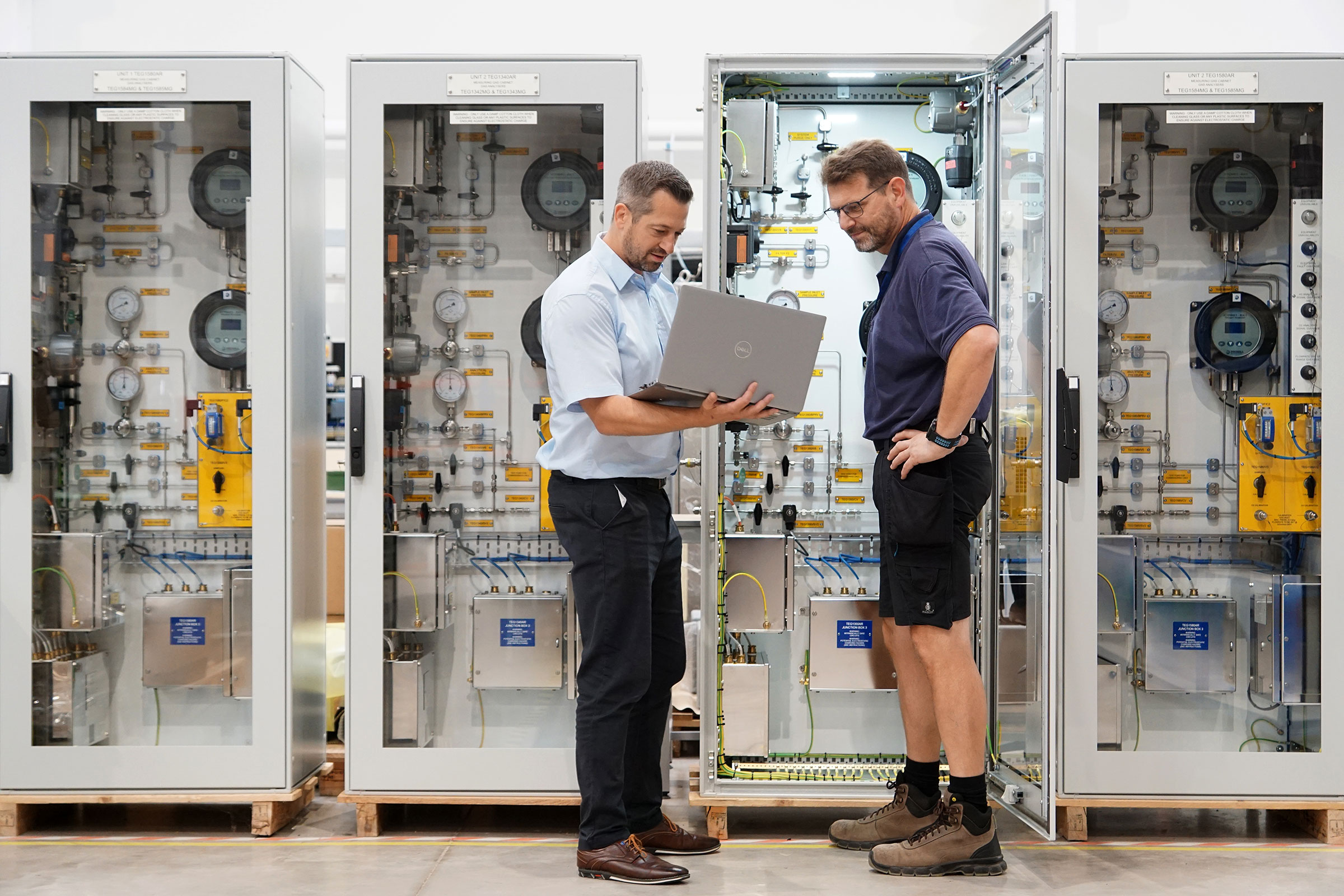
The system included a floor-standing PLC enclosure and a dedicated communication cabinet supporting network infrastructure between control rooms.

Integrated Testing

Hardware and software components were integrated and tested prior to delivery. This included:

  • Integrated System Testing at AMS premises
  • A formal Factory Acceptance Test (FAT) with client representatives

Site Installation and Commissioning

Following delivery, AMS Nuclear supported installation and commissioning activities including:

  • Installation of the PLC control cubicle and communication enclosure
  • Pre-commissioning system verification
  • Signal changeover from the legacy control system during a planned machine shutdown
  • Site Acceptance Testing (SAT) and operational verification.

The structured changeover process ensured that control loops were systematically validated and that operational behaviour closely replicated the legacy control system.

Documentation and Training

To support long-term maintainability, AMS Nuclear delivered a comprehensive documentation package including:

  • System drawings and configuration documentation
  • Operation and maintenance manuals
  • FAT and SAT test records
  • System training for operational and engineering staff.

This structured documentation ensures the control system can be confidently maintained and developed throughout its operational lifecycle.

A Practical Approach to Control System Modernisation

This project demonstrates how legacy industrial control systems can be modernised while preserving operational continuity. Key lessons included:

  • The importance of extracting configuration data from legacy systems early in the project
  • The value of integrated factory testing prior to site deployment
  • The benefits of selecting widely supported automation platforms to ensure long-term maintainability.

By combining robust engineering design with structured testing and collaborative delivery, AMS Nuclear successfully delivered a control system upgrade that maintains existing operational capability while creating a reliable platform for future improvements.

AMS Nuclear Certifications

ISO 9001:2015
ISO 14001:2015
ISO 45001:2018
Cyber Essentials